
DVC ROFR Explained: Why Disney Can Take Your Contract After You Sign
The Quick Take
DVC ROFR – Disney Vacation Club’s Right of First Refusal – lets Disney step in and buy any resale contract at the agreed-upon price, bumping out the original buyer. Disney uses it to protect pricing, and certain resorts and contract types are affected more than others.
Smart buyers approach ROFR with flexibility, realistic expectations, and a willingness to walk away when a deal isn’t right. Here’s what you actually need to know.
What’s In This Guide
01What DVC ROFR Actually Means for Buyers
02How the ROFR Process Works Step by Step
03Why Disney Uses ROFR and What It Means for Pricing
04Resorts and Contracts Most Affected by ROFR
05Strategies to Avoid Losing a Contract to ROFR
07What Happens After ROFR Is Waived
08How Timing and Market Cycles Affect Outcomes
10Why Passing ROFR Isn’t Always the Win
11Subtle Deal Factors That Influence Decisions
12What Experienced Buyers Do Differently
What DVC ROFR Explained Actually Means for Buyers
At its core, DVC ROFR explained is pretty simple. Disney keeps the right to step in and buy a resale contract under the exact same terms you agreed to with the seller.
Same price. Same details. You just get pushed out of the deal.
It sounds extreme at first. But from Disney’s side, it makes sense. They’re not just selling vacation points. They’re managing a long-term product tied to brand perception and pricing control.
In practice, buyers feel this as uncertainty. You’re not fully “in” until Disney says you are. That gap between signing and approval can feel longer than it actually is. Weeks, usually. But mentally, it drags.
Most people don’t realize how common this is until it happens to them. Or almost happens.
If you’re unsure how to spot a strong deal versus a risky one, it helps to understand how DVC resale contracts work before making an offer.
~30
Days Disney Has
to Decide
30-50%
Resale Savings
vs. Direct
$0
Lost If Disney
Takes the Contract
How the ROFR Process Works Step by Step
On paper, the process looks simple, but in reality feels different.
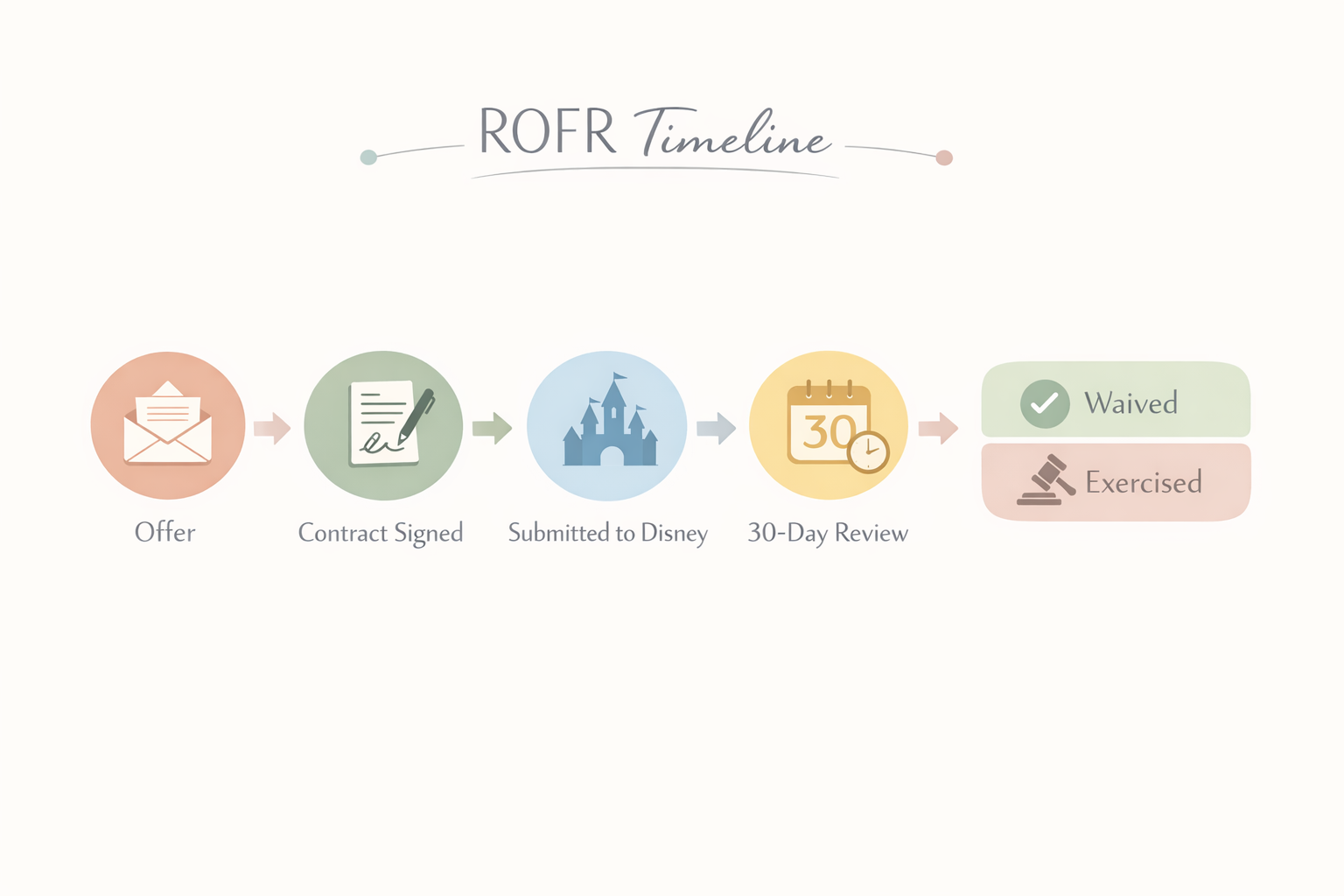
You agree on a price with the seller. Both sides sign. Then the contract gets submitted to Disney. That’s when everything pauses.
From there, Disney has a window, often around 30 days, to decide what they want to do. They either waive ROFR or exercise it. No middle ground.
If they waive it, you move forward. If they don’t, the contract is gone. Not delayed. Gone.
Here’s the part that tends to frustrate buyers. Disney doesn’t explain their decisions. There’s no feedback loop. No reasoning provided.
So people start looking for patterns. Historical pricing. Pass rates. Trends across resorts. It’s not perfect, but it’s something.
If you want a broader view of how those patterns shift over time, you’ll see a lot of data tracking here: DVC resale market data trends.
⚠ Heads Up
During the waiting period, expectations can get ahead of reality. People start planning trips or mentally “owning” the contract. That’s risky. Until ROFR clears, nothing is final.
If you want a clearer picture of how long each step takes, it helps to review the timeline of a DVC resale purchase before you get too far into the process.
Why Disney Uses ROFR and What It Means for Pricing
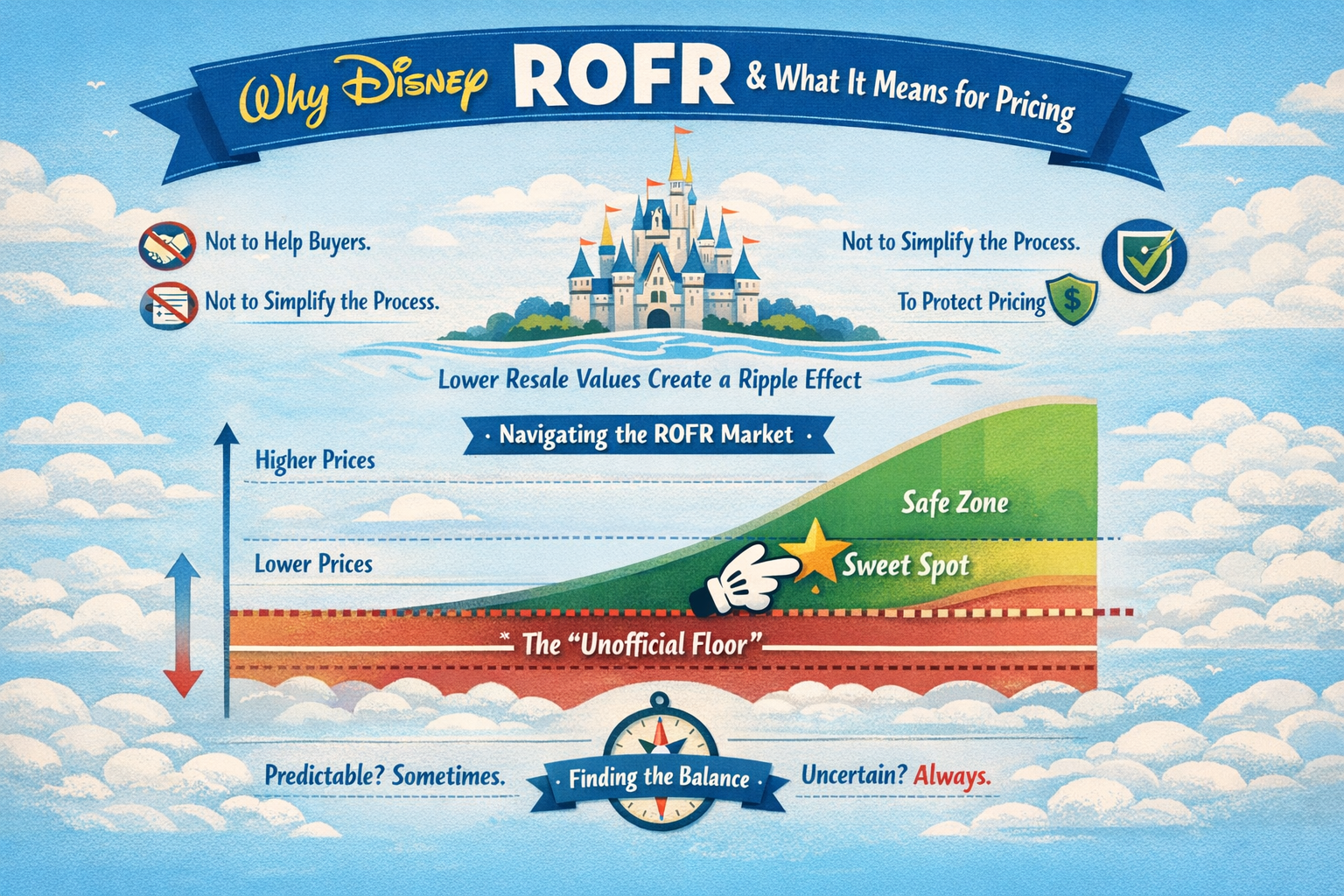
ROFR exists to protect pricing. Not to help buyers. Not to simplify the process.
When resale prices dip too far, it creates a ripple effect. Lower resale values can make direct purchases look overpriced. That’s a problem Disney actively manages.
So they step in. Selectively.
“You’re not just buying a contract. You’re navigating a controlled market.”
There’s an unofficial floor, even if no one publishes it. Go too far below it, and your odds drop.
Some buyers try to outsmart this. They look for that “sweet spot” just above recent ROFR activity. Sometimes it works. Sometimes it doesn’t. There’s still a layer of unpredictability that you can’t eliminate.
Resorts and Contracts Most Affected by ROFR
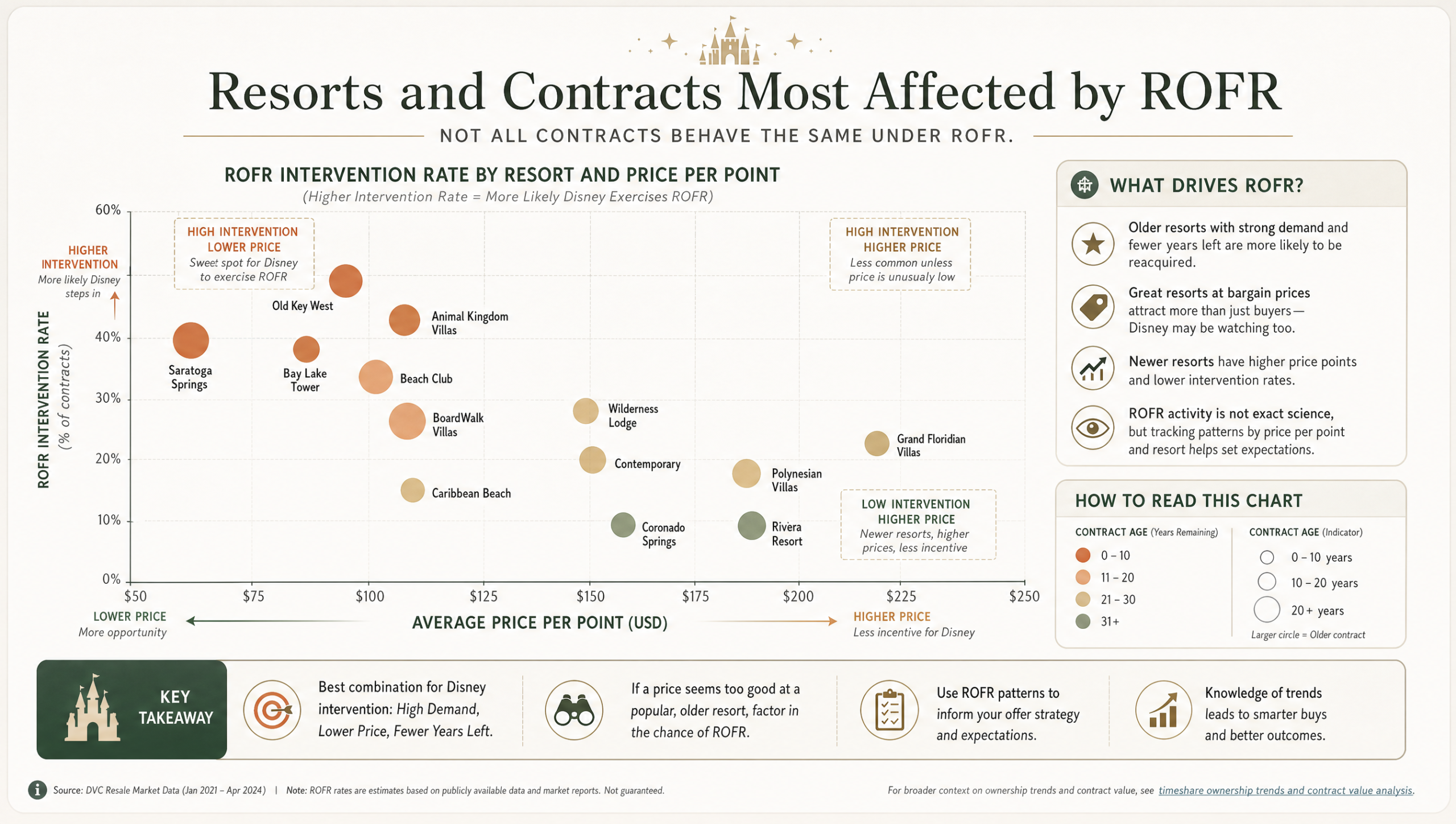
Not all contracts behave the same under ROFR. That’s something you start to notice pretty quickly.
Older resorts with strong demand tend to see more intervention. These are properties people actively want, often with fewer years left on the contract. That combination makes them attractive targets for Disney to reacquire.
Newer resorts? Different story. Higher price points. Less incentive for Disney to step in unless the deal is unusually low.
So if you’re chasing a well-known resort at a bargain price, there’s a decent chance you’re not the only one paying attention. Disney might be watching too.
Buyers often track ROFR activity by price per point and resort. It’s not exact science, but it helps frame expectations.
For broader context on how ownership trends influence value, you can look at reports like this: timeshare ownership trends and contract value analysis.

Strategies to Avoid Losing a Contract to ROFR
A lot of buyers come in focused on getting the lowest possible price. That instinct makes sense. But with ROFR in play, it can work against you.
In real-world scenarios, slightly higher offers often perform better. Not dramatically higher. But just enough to stay out of the danger zone.
💡 Pro Tip
Working with someone who tracks ROFR trends helps. Brokers who do this daily tend to have a feel for where deals are likely to pass. It’s not foolproof, but it’s better than guessing on your own.
Then there’s patience. Losing a contract to ROFR isn’t rare, and does happen.
Buyers who eventually succeed are usually the ones who stick with it and adjust. Not the ones who chase a perfect deal on the first try.
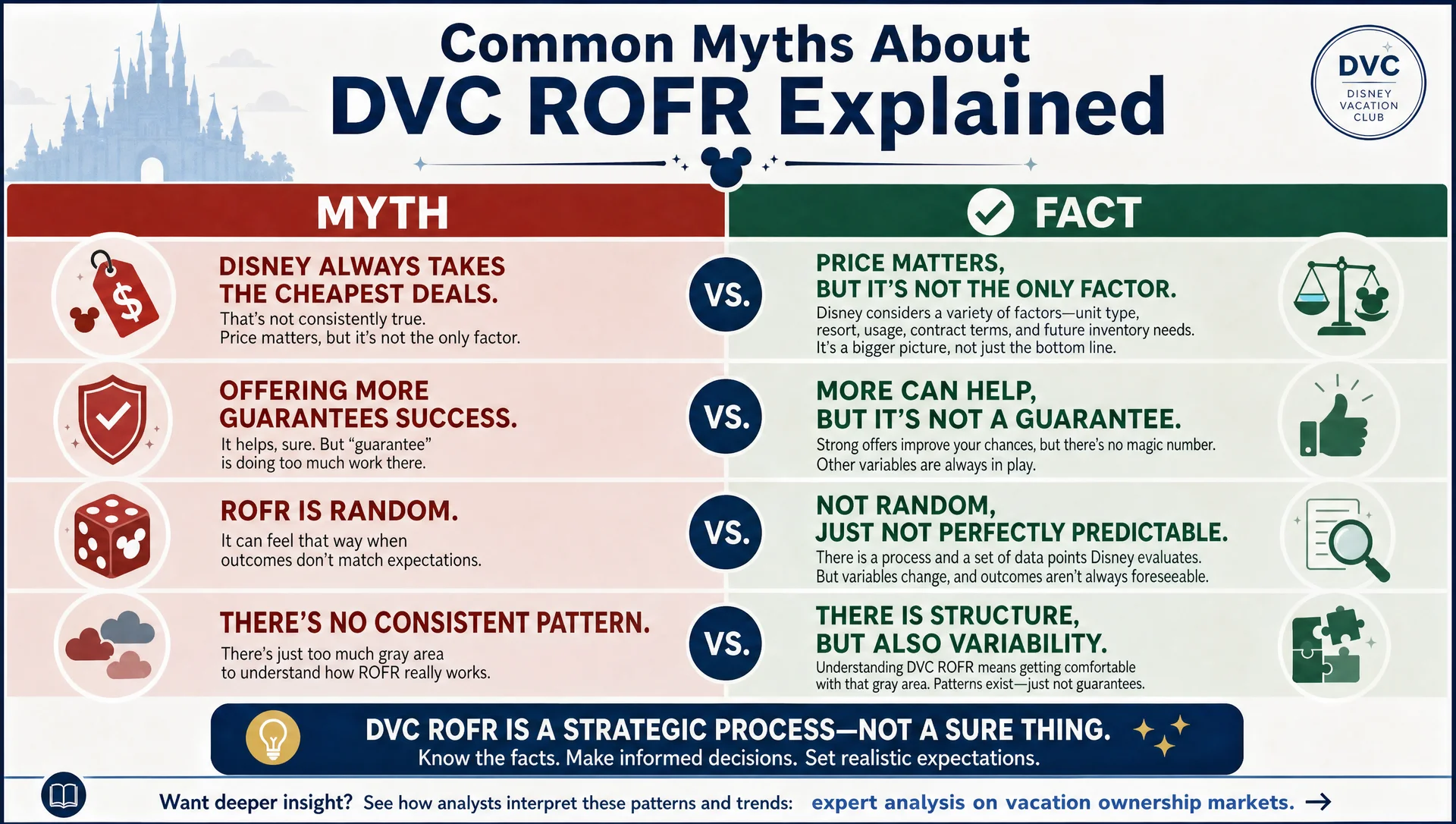
Common Myths About DVC ROFR Explained
One common belief is that Disney always takes the cheapest deals. That’s not consistently true. Price matters, but it’s not the only factor.
Another assumption is that offering more guarantees success. It helps, sure. But “guarantee” is doing too much work there.
Then there’s the idea that ROFR is random. It can feel that way when outcomes don’t match expectations. But, they’re just not perfectly predictable.
Understanding DVC ROFR means getting comfortable with that gray area. There’s structure, but also variability.
If you want deeper insight into how analysts interpret these patterns, resources like this can help: expert analysis on vacation ownership markets.
What Happens After ROFR Is Waived
Once you get the waiver, things feel different. Lighter, honestly.
But you’re not done yet.
After ROFR clears, the deal moves into closing. Payments get finalized. Documents get processed. Eventually, the membership transfers to you.
There’s still a delay before you can actually use your points. That part trips people up sometimes. They expect instant access. It doesn’t work that way.
This phase is more administrative than strategic. Still important, just less uncertain.
Some buyers rush through it, eager to book their first stay. Others take a step back and learn how to maximize their points. The second group usually gets more long-term value.
If you’re new to ownership, it’s worth taking a moment to understand how to use DVC points effectively so you can make smarter decisions after your contract closes.
How Timing and Market Cycles Quietly Affect ROFR Outcomes
ROFR activity isn’t static. It shifts. Sometimes gradually, sometimes in ways that feel abrupt if you’re in the middle of a purchase. Disney adjusts how aggressively they exercise ROFR depending on broader market conditions, and that can change your odds without any warning.
For example, when resale demand is high and inventory is tight, Disney tends to step in more often. It’s a way of rebuilding their own supply. On the other hand, when the resale market softens, they may back off a bit and let more contracts pass.
“A price that passed two months ago might not pass today. Or the opposite. That unpredictability is what throws people off.”
Some buyers try to wait for “better conditions,” but that’s tricky. You’re not just timing the market. You’re also competing with other buyers who are watching the same patterns. So while timing can influence outcomes, it’s rarely something you can control precisely.

The Emotional Side of ROFR That No One Talks About
Waiting on ROFR messes with your head a little.
You start checking your email more often than usual. You reread the contract. You look up the resort again, maybe even start planning how you’d use the points. It’s subtle, but you get attached before anything is finalized.
Then there’s the possibility of losing it. Even when you know it’s part of the process, it still stings. Especially if you felt like you found the “right” contract.
From experience, this is where expectations tend to break down. Buyers assume logic will carry the deal through. But ROFR isn’t purely logical from the outside looking in. There’s an internal strategy behind it that you don’t fully see.
The buyers who handle this phase best are usually the ones who stay a bit detached. Interested, but not invested yet. Easier said than done, obviously.

Why “Passing ROFR” Isn’t Always the Win People Think It Is
This might sound counterintuitive, but passing ROFR doesn’t automatically mean you got a great deal.
Sometimes it just means your price didn’t trigger Disney’s interest.
There are cases where buyers push offers higher than necessary just to feel “safe,” and yes, those deals often pass. But later, when they compare numbers or watch the market, they realize they could have negotiated differently.
On the flip side, a contract that gets taken by Disney isn’t always a bad outcome either. It usually signals that the price was strong enough to attract attention. That tells you something about where the market actually is.
So instead of viewing ROFR as pass equals good and taken equals bad, it’s more useful to treat it as feedback. Indirect, but still informative.
That shift in perspective helps you adjust faster if you need to make another offer.

Subtle Deal Factors That Can Influence ROFR Decisions
Price per point gets most of the attention. For good reason. It’s the easiest metric to compare.
But it’s not the only thing in play.
Contract size, for example, can matter more than people expect. Smaller contracts are often more flexible and easier to resell, which can make them more attractive for Disney to reacquire in certain situations.
Then there’s the use year. It’s not always a major factor, but in some cases, it can influence how desirable a contract is internally. Most buyers don’t think about this at all.
Point availability also plays a role. A stripped contract, where points have already been used or borrowed, might be less appealing compared to one with full availability. That difference doesn’t always show up clearly in ROFR discussions, but it’s there.
None of these factors guarantee an outcome. But together, they shape how a contract is evaluated behind the scenes.
What Experienced Buyers Do Differently
Buyers who’ve gone through ROFR more than once tend to approach things differently. They don’t panic over a single lost contract. They don’t anchor too hard on one price point either.
Instead, they think in ranges.
They look at recent passes, recent takings, and place their offer somewhere that feels competitive without being reckless. It’s less about hitting the absolute lowest number and more about staying in a zone that’s likely to clear.
They also move faster when the right contract appears. Not impulsively, but without overanalyzing every detail. Because hesitation can cost you just as much as ROFR.
And maybe most importantly, they expect friction. That mindset alone changes how the process feels. What seems frustrating to a first-time buyer often feels normal to someone who’s been through it already.

When Walking Away Is Actually the Better Move
Not every contract is worth chasing. That’s another lesson people tend to learn the hard way.
If a deal requires you to stretch beyond what you’re comfortable paying just to avoid ROFR, it might not be the right deal to begin with. The fear of losing out can push buyers into decisions that don’t hold up later.
There’s always another contract. Maybe not identical, but close enough.
In real-world scenarios, the buyers who stay disciplined usually end up happier with their purchase. They don’t just get through ROFR. They land on something that fits their long-term plans.
So yes, ROFR matters. A lot. But it shouldn’t override your entire buying strategy.
Sometimes the smartest move is stepping back, resetting, and waiting for a better opportunity.
Final Thoughts on DVC ROFR Explained
If you strip it down, DVC ROFR explained comes down to managing expectations.
It’s not an obstacle you can remove. It’s part of the system. Once you accept that, your approach changes.
Buyers who struggle with ROFR often go in expecting a straightforward purchase. Offer, accept, done. That’s not how this works.
The ones who adapt tend to do better. They price strategically. They stay flexible. And they don’t overreact when a deal falls through.
Because sometimes it will.
At the end of the day, DVC ROFR isn’t about avoiding the process. It’s about understanding how to move through it without getting thrown off when things don’t go exactly as planned.
Ready to Find Your DVC Contract?
Navigating ROFR is easier when you’re not doing it alone. At Magical Vacation Pros, we’ve helped hundreds of families buy and sell DVC contracts – and we know exactly how to price your offer to give it the best chance of passing.
Browse our current DVC resale listings to see what’s available right now, or talk to a DVC specialist who can walk you through the entire process from offer to ownership.
About the Author
Kenny Smith is a Disney Vacation Club specialist and the founder of Magical Vacation Pros, where he helps families navigate the DVC resale market with confidence. With years of experience brokering contracts across every Disney Vacation Club resort, Kenny has guided hundreds of buyers and sellers through the ROFR process, contract closings, and long-term ownership planning. His goal is simple: help families get more Disney for less, without the guesswork.
Have a question about DVC resale? Reach out to Kenny and the Magical Vacation Pros team anytime.
Frequently Asked Questions About DVC ROFR
Quick Answers for DVC Buyers
How long does the DVC ROFR process take?
Disney typically has up to 30 days to exercise or waive their Right of First Refusal after a contract is submitted. Most decisions come back within 2–4 weeks, though timelines can vary depending on volume and the resort involved.
What happens if Disney exercises ROFR on my contract?
If Disney exercises ROFR, they purchase the contract from the seller at your agreed-upon price and terms. You don’t lose any money – your deposit is fully refunded – but you do lose the contract and need to start the search again.
Will I lose my deposit if Disney takes the contract?
No. If Disney exercises ROFR, your earnest money deposit is returned in full. You’re only out the time you spent waiting – not the money.
What’s the best price to offer to pass ROFR?
There’s no published threshold, but most experienced buyers track recent ROFR pass rates by resort and price per point. Offering slightly above recently exercised contracts at the same resort tends to give you the best chance of passing without overpaying. A specialist can help you find that sweet spot.
Does Disney always exercise ROFR on the cheapest contracts?
Not always. Price is a major factor, but it’s not the only one. Disney also considers resort demand, contract size, use year, and current inventory needs. A low price increases the odds, but doesn’t guarantee Disney will step in.
Which DVC resorts are most affected by ROFR?
Older resorts with high demand – like Bay Lake Tower, Beach Club Villas, BoardWalk Villas, and Polynesian – tend to see more ROFR activity. Newer resorts with higher price points generally see less intervention unless a contract is priced well below market.
Can I appeal a ROFR decision?
No. Once Disney exercises ROFR, the decision is final. There’s no appeal process and Disney doesn’t provide reasoning for their decisions. Your best move is to start looking at other contracts and adjust your offer strategy based on what you learned.
Is buying DVC resale still worth it with ROFR in play?
Yes. Even with ROFR, DVC resale contracts are typically 30–50% cheaper than buying direct from Disney. Most contracts pass ROFR, and the savings far outweigh the inconvenience of the waiting period. Working with an experienced broker helps you avoid common pricing mistakes that trigger ROFR.
How can I improve my chances of passing ROFR?
Track recent ROFR results at your target resort, work with a broker who monitors pass/take patterns, avoid pricing significantly below market, and stay flexible on use year and contract size. Patience and good information are your two biggest advantages.
Read More:
DVC Resale Contract: The Complete Walkthrough for Smart Buyers