

DVC Use Year Explained: How to Choose the Right One
Your DVC use year – the month your points reset annually – should be chosen based on when you typically travel, not price or availability. Pick one that falls a few months before your usual travel window so you have a recovery buffer if you need to cancel. Get it right before you buy; misaligning your use year with your travel habits is one of the most common and avoidable mistakes resale buyers make.
DVC Use Year: What It Really Means
A DVC use year is simply the month your annual points reset. Each contract has a specific month. For example, a February use year means your points are issued every February and expire the following January if unused. That creates a 12-month usage window tied to your contract.
Here’s where people get tripped up. The use year is not when you travel. It’s when your points are valid. You can book trips outside that month range as long as the reservation falls within the valid use year period.
Think of it like a financial cycle, not a vacation calendar. Once you see it that way, everything becomes easier to plan.
 Why DVC Use Year Matters for Resale Buyers
Let’s be honest. If you’re buying resale, you’re already trying to maximize value. Ignoring use year is like buying a discounted plane ticket and forgetting the departure time.
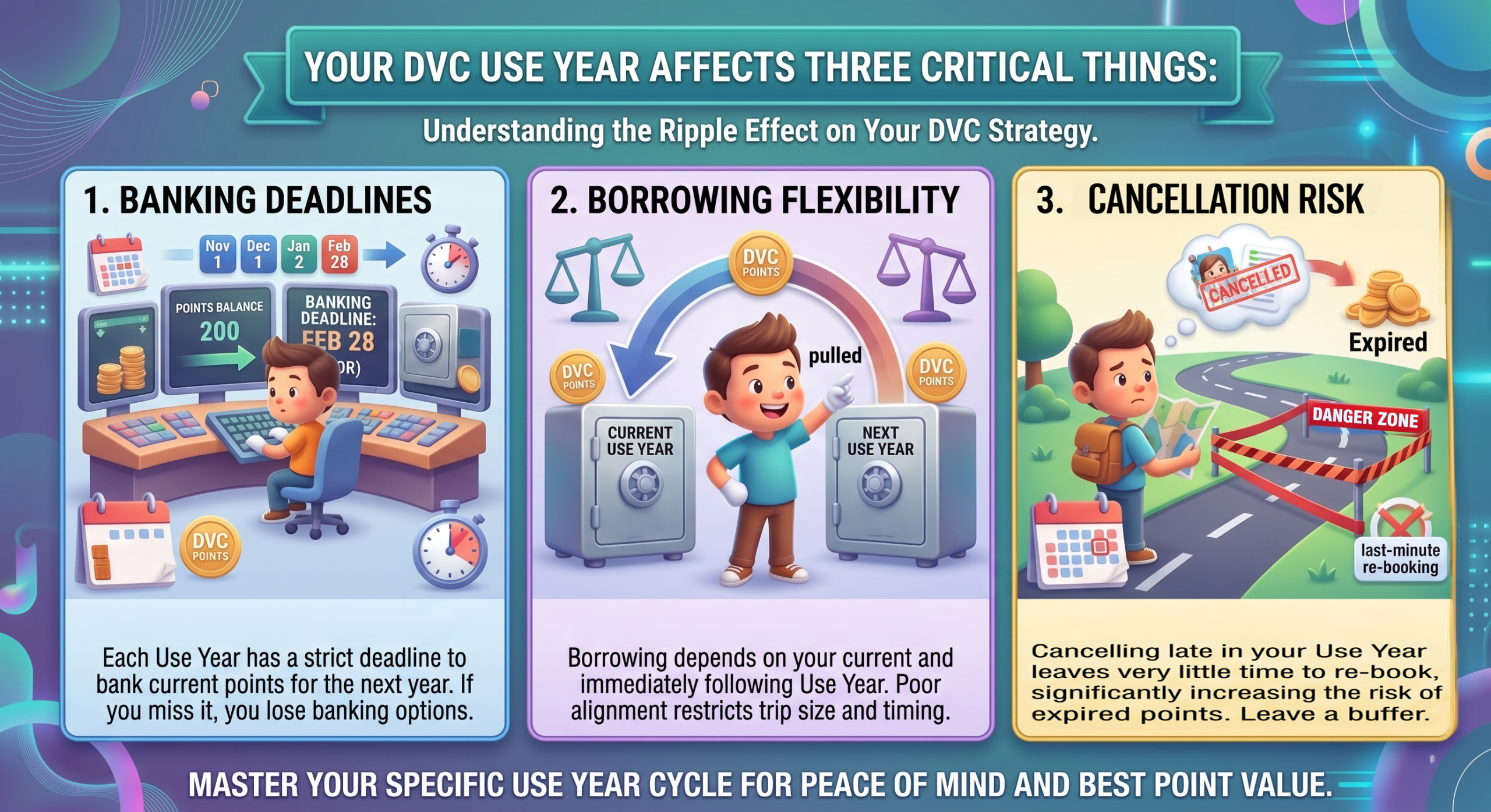
Your DVC use year affects three critical things:
Banking deadlines
Borrowing flexibility
Cancellation risk
If you cancel a trip close to the end of your use year, you could lose points if they expire before you can reuse them. It happens more often than people admit.
For example, imagine you have a June use year and cancel a May trip. May falls at the very end of that use year cycle, and the banking deadline has already passed months earlier. Those points have to be used within weeks or they’re gone.
Industry data shows unused travel credits are a common loss point for timeshare owners: timeshare usage behavior data.
If your travel habits don’t align with your use year, you’ll constantly fight the system instead of using it smoothly.
How Banking and Borrowing Work With Your Use Year
Banking and borrowing are the tools that give DVC flexibility, but they’re tied directly to your use year.
Banking lets you move current-year points into the next use year. Borrowing pulls future points into the current one.
Each use year has a banking deadline, which falls roughly 8 months into the cycle. Miss that deadline and you lose the ability to save unused points.
Example:
February use year
Banking deadline is around September
Any unused points after that must be used or they expire
Borrowing has fewer restrictions, but once you borrow, those points are locked. You can’t return them to the future.
Here’s a quick reality check. If you’re constantly borrowing, you’re overextending. If you’re always banking late, you’re misaligned.
For a full breakdown on banking and borrowing, see our guide here: Banking and Borrowing
Understanding DVC Use Year for Your Travel Style
You should choose a use year that comes a few months before your usual travel time. Why? Because it protects you if you need to cancel.
Let’s say you travel every December. A February or March use year works well. If you cancel, you still have months left to rebook or bank.
Now flip that. If you have a December use year and cancel a December trip, your points are about to expire. That’s risky.
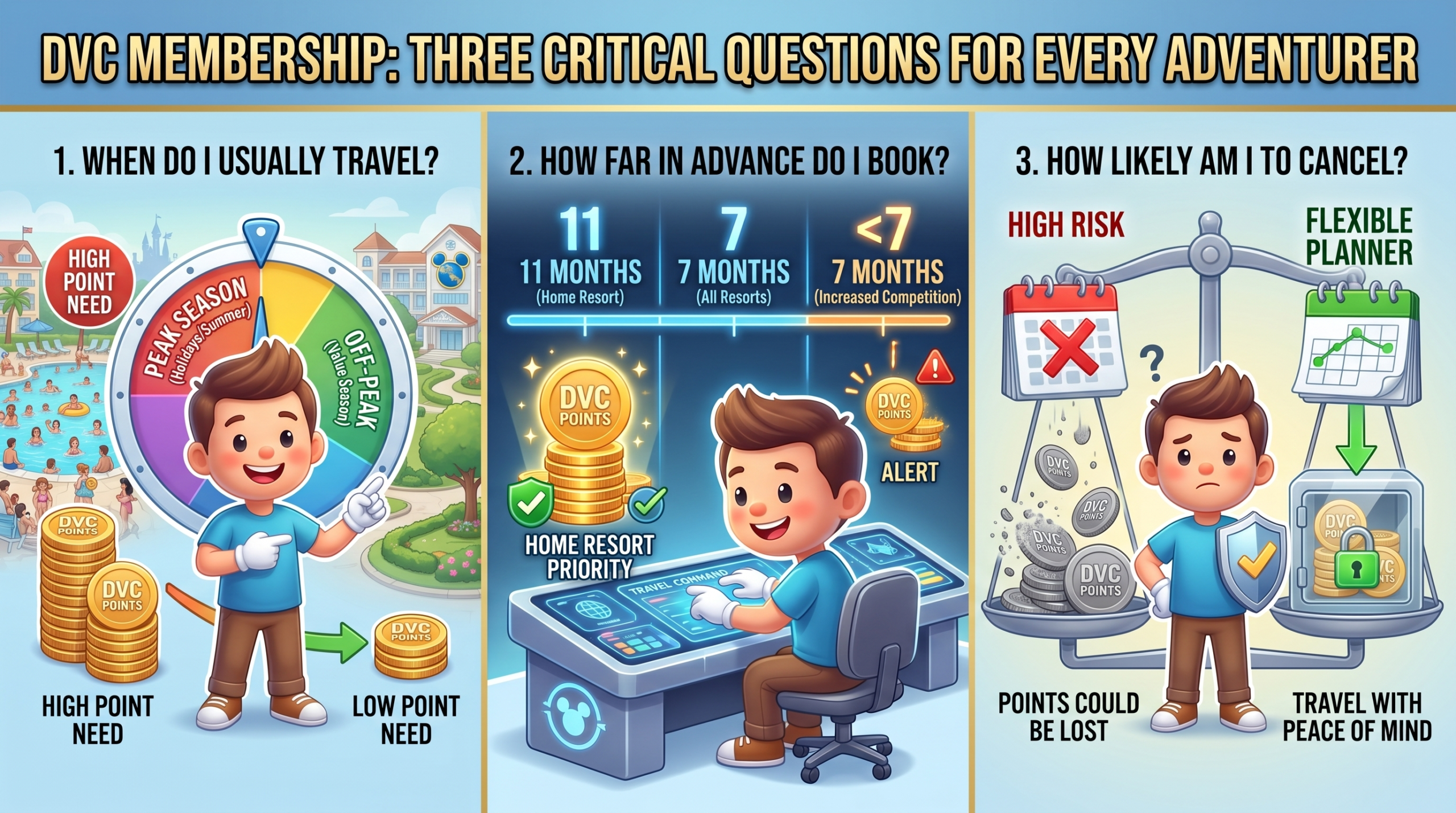
Ask yourself:
When do I usually travel?
How far in advance do I book?
How likely am I to cancel?
Your answers should guide your decision more than price or resort.
Your travel habits should guide your use year choice, especially if you want to avoid unnecessary stress when booking or canceling trips.
Common Mistakes Buyers Make With Use Year
Let’s call these out directly because they’re avoidable.
First mistake. Choosing the cheapest contract regardless of use year. Savings upfront can lead to lost points later.
Second mistake. Confusing use year with booking window. They’re not the same. Your 11-month or 7-month booking advantage is separate from your use year cycle.
Third mistake. Ignoring cancellation scenarios. Life happens, and if your use year doesn’t give you recovery time, you’re exposed.
Fourth mistake. Overestimating flexibility. Yes, DVC is flexible. But only if you understand how to use the system properly.
If you avoid these mistakes, you’re already ahead of most buyers.
Best Use Year Options Based on Travel Patterns
Let’s get specific. Here’s how different use years align with common travel habits.
If you travel in winter holidays like December, January, or early February, a February or March use year is ideal. It gives you a buffer if plans change.
If you prefer summer travel, like June through August, a February, March, or April use year works best. Your points will be several months into their cycle by the time summer arrives, giving you a real recovery window if you need to cancel or rebook.
If you travel mostly in the fall, like September through November, a use year that starts in spring (April or May) lines up well. You’ll have months of runway before your trip and a healthy banking window if something changes.
If you’re a flexible traveler with multiple trips per year, the goal is a use year that sits a few months before your heaviest travel season. Consistency matters more than spreading risk.
There’s no universally best use year. There’s only the best one for your habits.
For a broader look at timeshare usage trends, you can review: global vacation ownership statistics.
There’s no universally perfect use year, which is why comparing contracts carefully is key before making a final decision.
If you’re trying to balance cost, location, and long-term value, this ranking of the top DVC resorts by value in 2026 gives a clear snapshot of which options stand out right now: best DVC resorts for resale buyers compared.

Advanced Tips for Maximizing Your Use Year
Now we’re getting into strategy.
First, align your use year with your busiest travel season, not your dream trip. Consistency matters more than occasional plans.
Second, always track your banking deadline. Set reminders. Seriously. Missing it once is enough to regret it.
Third, avoid stacking borrowed points unless you’re certain about future travel. It reduces flexibility and increases risk.
Fourth, consider owning multiple contracts with different use years if you travel often. It sounds complex, but it can give you more control.
Fifth, think about resale liquidity. Some use years are more common and easier to sell later.
Expert commentary often highlights planning discipline as the key to maximizing timeshare value: expert advice on vacation ownership planning.
Real-World Scenarios That Show Why Use Year Matters
Let’s move beyond theory and talk about what actually happens in real life. Because this is where understanding DVC use year really clicks.
Picture this. You planned a family trip for early June. Flights booked, park reservations locked in, everything lined up. Then something comes up. Maybe work gets in the way. Maybe someone gets sick. You cancel.
If your use year starts in June, you’re suddenly in a tight spot. Your points are about to expire unless you already banked them. Now you’re scrambling to book something fast or risk losing value.
Now compare that with a February use year. Same cancellation, same timing. But now you’ve got months to rebook or bank your points. Way less stress. Way more control.
This is why people who truly understand the system don’t treat use year as a minor detail. It’s a risk management tool.
How Use Year Impacts Last-Minute Travel Decisions
Here’s something a lot of buyers don’t think about. Not every trip is planned a year in advance. Sometimes you just want to book something spontaneous.
And yes, DVC can work for last-minute travel. But your use year determines how easy that is.
If you’re near the end of your use year with unused points, you might feel pressure to book anything just to avoid losing them. That leads to rushed decisions and less ideal trips.
On the flip side, if you’re early in your use year, you’ve got breathing room. You can wait for better availability, better flights, better timing.
That difference changes your entire experience. One feels forced. The other feels flexible.
Travel flexibility is often tied to timing behavior, not just availability.
So if you’re someone who likes keeping options open, your use year should reflect that. Don’t box yourself into a corner.
The Emotional Side of Choosing the Wrong Use Year
Let’s be honest for a second. Losing points doesn’t just hurt financially. It’s frustrating.
You paid for those points. You planned around them. And then suddenly, because of timing, they’re gone or hard to use.
That’s the kind of mistake that sticks with you. Not because it’s complicated, but because it was avoidable.
I’ve seen buyers obsess over saving a few hundred dollars on resale pricing, then lose far more value due to poor use year alignment. It’s backwards thinking.
The emotional cost matters too. When your system works against you, it takes the fun out of ownership.
If you’re investing in something meant to create vacations and memories, it shouldn’t feel stressful.
Why Some Buyers Intentionally Choose “Imperfect” Use Years
Here’s a slightly controversial take. Sometimes choosing a “less ideal” use year can still make sense.
Wait, what?
Yes, because pricing and availability in the resale market aren’t evenly distributed. You might find a great deal on a contract that doesn’t perfectly match your travel habits.
In that case, the question becomes strategic. Can you work around it?
If you’re disciplined with banking and flexible with travel timing, you can still make it work. Especially if the savings are significant.
But this only works if you understand the system deeply. Otherwise, you’re setting yourself up for friction.
Think of it like buying a house slightly outside your ideal area. It can be a smart move, but only if you’ve thought through the trade-offs.
The Role of Use Year in Long-Term Ownership Strategy
Most people think short term when buying DVC. They focus on their next trip or maybe the next year. But use year becomes even more important over time.
Why? Because your travel patterns evolve.
Maybe you start traveling in summer, then shift to holiday trips later. Maybe your work schedule changes. Maybe kids grow up and school calendars shift.
A well-chosen use year gives you room to adapt. A poorly chosen one forces you to constantly adjust your plans.
Long-term ownership is about reducing friction, not just maximizing value.
This is especially important if you plan to hold your contract for 10, 20, or even 30 years. Small inefficiencies compound over time.
How Experienced Owners Actually Use Their Use Year
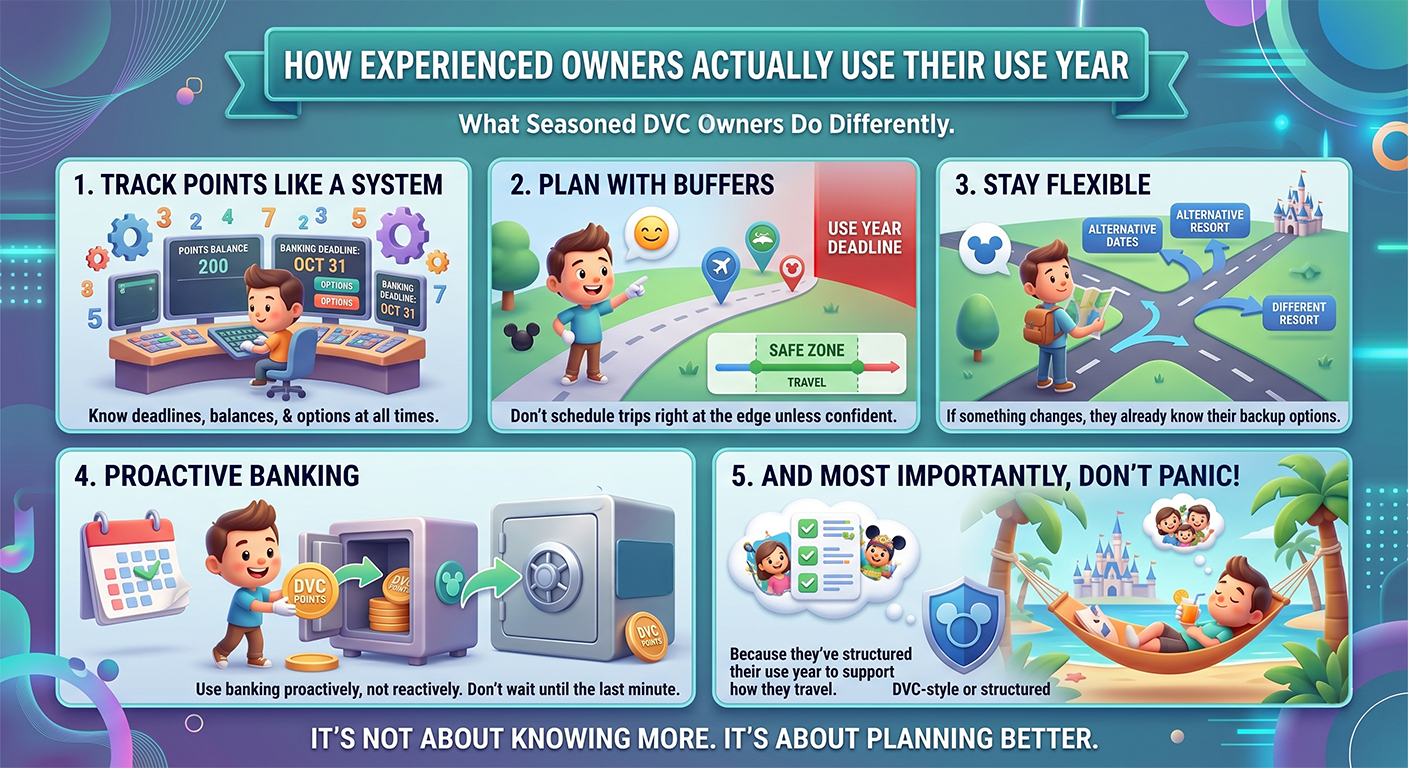
Let’s look at what seasoned DVC owners do differently.
First, they track their points like a system. They know their deadlines, their balances, and their options at all times.
Second, they plan with buffers. They don’t schedule trips right at the edge of their use year unless they’re confident.
Third, they stay flexible. If something changes, they already know their backup options.
Fourth, they use banking proactively, not reactively. They don’t wait until the last minute.
And most importantly, they don’t panic. Because they’ve structured their use year to support how they travel.
That’s the real difference. It’s not about knowing more. It’s about planning better.
Final Thought Before You Choose Your Use Year
Here’s a simple way to think about it.
Your use year should work for you, not against you.
If you’re constantly adjusting, stressing, or rushing to use points, something is off. And most of the time, it comes back to timing.
Understanding DVC use year at a deeper level gives you control. It turns what feels like a rigid system into something flexible and predictable.
And once you get that right, everything else becomes easier.
Conclusion: Understanding DVC Use Year
Understanding DVC use year is not just a technical detail. It’s the backbone of how you use your points efficiently. If you align your use year with your travel habits, you’ll avoid stress, wasted points, and last-minute scrambling.
Most resale buyers focus on price and location first. That’s fine, but timing should sit right next to those priorities. A well-chosen use year gives you flexibility when plans change, and that’s where real value shows up.
If you take one thing from this guide, let it be this. Understanding DVC use year before you buy is far easier than fixing mistakes after. Get it right upfront, and your ownership experience becomes smooth, predictable, and far more enjoyable.