

DVC Banking and Borrowing: Maximize Value with Smart Point Strategies
If you own Disney Vacation Club points, you’ve probably heard about DVC banking and borrowing. But are you really using it to your advantage? Many members leave serious value on the table simply because they don’t understand how flexible their points can be.
This lets you shift points between Use Years so you can plan bigger trips, handle busy seasons, or avoid wasting unused points. It sounds simple. In practice, it can feel confusing. Deadlines, restrictions, and booking windows matter.
Here’s the good news. Once you understand the rules, you can stretch your membership further than you thought possible. Let’s break it down to show you how to make every single point count.
What Is It and Why Does It Matter?
At its core, this gives you control over time. You’re not stuck using points only in the year they’re assigned. You can move them forward or pull them back depending on your vacation goals.
Banking means moving unused points from your current Use Year into the next one. Borrowing means taking points from your upcoming Use Year and using them now. That’s it. Simple concept. Powerful results.
Why does it matter? Because vacation needs change. Maybe you want a bigger villa for a family reunion. Maybe airfare spikes and you delay travel. Or maybe you finally want that bucket list stay at a deluxe resort during peak season. With the right strategy, it lets you adapt instead of settling.
If you’re new to ownership, it helps to understand how point charts and seasons work first.
How This Actually Works
Let’s get specific. Each DVC contract has a Use Year. That’s the month your annual points renew. It doesn’t control when you can travel. It controls when your points reset.
Banking Points
You can bank points from your current Use Year into the next Use Year. But you must do it before your banking deadline. That deadline depends on your Use Year month.
Once banked, those points must be used in the next Use Year. You can’t bank them again. This is a one-time move.
Miss the deadline? Those points expire. No refunds. No do-overs. That’s why understanding the calendar is critical.
Borrowing Points
Borrowing is more flexible in timing. You can borrow points from your next Use Year at the time you make a reservation, as long as you’re within booking windows.
But here’s the catch. Once borrowed, those points stay in the earlier year. If you cancel the trip, they don’t return to the future year. They remain in the current Use Year and may be subject to holding rules.
The Real Benefit
It shines when you plan intentionally. For example, combining this year’s points with borrowed points lets you book a high-demand villa during holidays. Or you can bank points now to take a longer vacation next year.
According to the Disney Vacation Club official member guidelines, banking and borrowing is designed to provide flexibility while protecting inventory fairness for all members.
Flexibility is powerful. But only if you use it wisely.
Smart Ways to Use This for Maximum Value
Let’s talk strategy. Because simply knowing the rules isn’t enough. You need a plan.

animal kingdom lodge view
- Plan Big Trips Every Other Year: Some members alternate between small and large vacations. One year, they take a short stay using only current points. The next year, they combine banked and current points for a premium experience. This approach works great for members with smaller contracts. It creates a luxury rhythm without increasing annual dues.
- Book High-Demand Travel Periods: Holiday weeks and Food and Wine season cost more points. It allows you to pool points to secure those expensive dates. Let’s be honest. If you want Christmas at a deluxe resort, you’ll need more than a single year’s allocation in many cases.
- Upgrade Your Room Category: Standard view is fine. But sometimes you want the savanna view or a one-bedroom villa. Borrowing future points can give you that upgrade without buying more contracts. Just remember that future flexibility shrinks once you borrow.
- Avoid Expiration: Banking protects unused points from expiring. According to a timeshare usage behavior study, unused vacation inventory is one of the biggest reasons owners lose value in timeshare systems. Don’t let that be you.
Common Mistakes
Here’s the thing. Most frustration with this comes from poor timing, not bad policy.
Missing Banking Deadlines
Every Use Year has a specific banking cutoff. Miss it and those points disappear. Set reminders. Seriously.
If you struggle tracking dates, you might benefit from a structured calendar system.
Over-Borrowing
Borrowing feels easy. You click a button and suddenly your dream vacation is confirmed. But next year arrives with fewer points available. Then what? You’re stuck either taking a smaller trip or borrowing again. It can create a cycle.
I’ve seen members unintentionally lock themselves into a pattern where every trip depends on future borrowing. That’s risky.
Ignoring Holding Rules
If you cancel a reservation made with borrowed points close to check-in, those points may go into holding status. That limits booking flexibility.
Before making changes, review your options carefully.
Assuming You Can Undo Moves
Banked points can’t be banked again. Borrowed points don’t return to their original year. Once you shift them, that decision sticks.
Planning prevents regret.
Advanced Planning Tactics
Ready to level up? Let’s explore more sophisticated uses of it.
Stacking Points for Bucket List Resorts
Some resorts cost more per night. Especially newer properties. If you want an extended stay at a premium location, stack three years of points. Bank current year. Use next year. Borrow from the following year.
That’s legal within DVC rules. But it requires careful math.
Coordinating Multiple Contracts
Own contracts with different Use Years? That adds complexity. You can’t freely mix points without tracking deadlines for each.
Strategic owners align travel dates to maximize overlap between contracts. It takes organization. But the payoff can be massive flexibility.
Renting Points as a Backup Plan
If you’ve borrowed heavily and next year feels tight, renting points from another member can bridge the gap.
Industry data from the vacation ownership market research report shows point rentals are a growing segment in vacation ownership.
Still, rentals cost money. So think of this as a safety net, not a habit.
Watching Economic Trends
Travel demand shifts. Resort availability changes. Broader tourism research from the global tourism demand analysis suggests that peak travel pricing trends often follow predictable patterns.
When demand rises, point requirements feel tighter. Banking early gives you leverage before competition intensifies.
Is This Right for Every Member?
Short answer? Almost everyone benefits from understanding it. But not everyone should use it aggressively.
If you prefer predictable, same-time-every-year vacations, you may rarely need to borrow. Banking occasionally to avoid expiration might be enough.
If you love spontaneity, banking gives you breathing room. Borrowing can lock you into future obligations.
Ask yourself:
- Do I travel every year consistently?
- Am I okay reducing next year’s flexibility?
- Am I planning something special that justifies stacking points?
There’s no universal answer. That’s the beauty of it. It adapts to your lifestyle.
Practical Example: Real-World Point Strategy
Let’s walk through a scenario.
You own 150 points annually. This year, you only use 100 points. Instead of wasting 50, you bank them. Next year, you now have 200 points available. You decide to borrow 50 from the following year. Now you can book a 250-point vacation.
That’s a significant upgrade from your normal stay.
But next year, you’ll only have 100 points available because you borrowed 50. So you either take a smaller trip or bank carefully again.
See the pattern? This works best when you map at least two to three years ahead. It’s like chess. You don’t just think about the next move. You think about the next several.
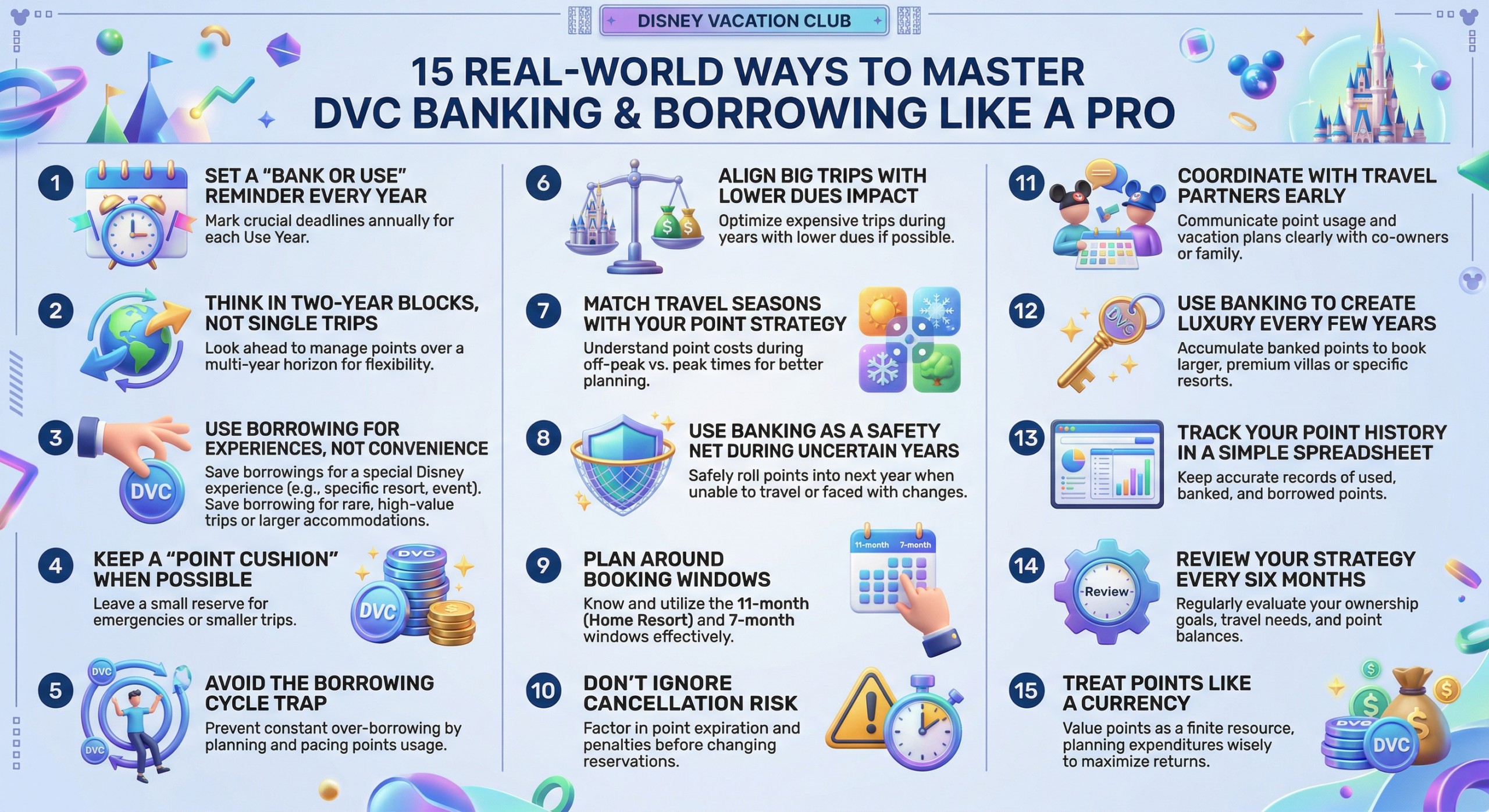
15 Real-World Ways to Master DVC Banking and Borrowing Like a Pro
Let’s get practical. You know the rules. You understand the deadlines. Now it’s time to talk about how real members actually use it in everyday life. These aren’t theoretical ideas. These are smart, tested habits that can stretch your points further without adding stress.
Here are 15 ways to get more value, more flexibility, and fewer regrets.
- Set a “Bank or Use” Reminder Every Year: Life gets busy. Work piles up. Kids have schedules. It’s easy to forget your banking deadline until it’s too late. Create a recurring calendar reminder three months before your banking deadline. Not one week before. Three months. That gives you breathing room. This simple habit prevents the most common mistake in this. Missed deadlines equal lost value. No one wants that.
- Think in Two-Year Blocks, Not Single Trips: Here’s a mindset shift that changes everything. Don’t plan one vacation. Plan two years of vacations at once. Ask yourself: What am I doing this year? What do I want next year? Should I bank now to make that future trip better? When you zoom out, it becomes a strategic tool instead of a reaction to last-minute plans.
- Use Borrowing for Experiences, Not Convenience: Borrowing is powerful. But don’t borrow just because you’re a few points short for a slightly better view. Borrow for meaningful upgrades. A larger villa for extended family. A holiday trip you’ve always dreamed of. A milestone anniversary stay. If the memory justifies the reduced flexibility next year, it’s worth it. If it doesn’t, pause.
- Keep a “Point Cushion” When Possible: If your contract allows, try not to run your balance down to zero every year. Even a small cushion gives you flexibility for surprise availability or short-notice bookings. It also reduces pressure to borrow constantly. Members who treat this as a balancing act rather than a max-out strategy tend to feel less stressed long term.
- Avoid the Borrowing Cycle Trap: This one is huge. Some members borrow this year. Then next year feels tight, so they borrow again. And again. Suddenly, every vacation depends on future points. That cycle removes your margin for error. Break it by occasionally taking a smaller trip or banking instead of borrowing. Financial flexibility matters. Even with vacation ownership.
- Align Big Trips with Lower Dues Impact: Annual dues rise over time. That’s normal. If you’re planning a stacked three-year trip using banked and borrowed points, consider timing it before significant dues increases hit. You’ll get more perceived value from points that cost less. It’s a subtle move. But it adds up.
- Match Travel Seasons with Your Point Strategy: Point charts fluctuate by season. Lower-demand weeks require fewer points. If you’ve borrowed heavily, consider traveling in lower-point seasons the following year. That helps rebalance your account without feeling like you downgraded your trip. Strategic season planning pairs beautifully with it.
- Use Banking as a Safety Net During Uncertain Years: Sometimes life throws curveballs. Job changes. Health shifts. Schedule chaos. If you suspect you may not travel this year, bank early. Don’t wait. Banked points give you peace of mind. You preserve value without forcing a rushed trip that doesn’t fit your schedule.
- Plan Around Booking Windows: Booking at 11 months versus 7 months can change availability dramatically. If you’re stacking points for a high-demand resort, combine this with early booking. Otherwise, you may pool points and still miss out. Strategy only works when paired with timing.
- Don’t Ignore Cancellation Risk: Let’s be honest. Plans change. If you’re booking far ahead using borrowed points, consider how likely that trip is to happen. If cancellation risk is high, banking may be safer than borrowing. Borrowed points don’t return to their original year. That detail matters more than people realize.
- Coordinate with Travel Partners Early: Traveling with extended family or friends? Align expectations early. If you’re borrowing to secure a large villa and someone backs out, you’re stuck managing the point impact. Clear communication reduces financial strain. It works best when everyone is on the same page.
- Use Banking to Create Luxury Every Few Years: Here’s a fun approach. Alternate between standard trips and luxury upgrades. Bank during lighter years. Then go big. That savanna view. That two-bedroom villa. That peak holiday week. It feels better when you know you planned for it intentionally. This rhythm keeps vacations exciting without increasing ownership costs.
- Track Your Point History in a Simple Spreadsheet: You don’t need complex software. Simply track: points received, points banked, points borrowed, expiration dates, and planned trips. When you see it visually, patterns emerge. You’ll notice if you’re over-borrowing or consistently leaving points unused. This becomes clearer when numbers are transparent.
- Review Your Strategy Every Six Months: Your travel style may evolve. Kids grow up. Work flexibility changes. Revisit your point strategy twice a year. Ask yourself if your current approach still fits your lifestyle. What worked three years ago might not fit today. Flexibility is the whole point.
- Treat Points Like a Currency: Because they are. Would you casually spend next year’s paycheck without thinking? Probably not. Borrowed points deserve the same caution. When you respect your points as a limited resource, it becomes intentional instead of impulsive.
Why This Approach Actually Works
Advice is everywhere. But habits stick.
These 15 strategies aren’t complicated. They’re small mindset shifts. When combined, they create a stable, flexible ownership experience.
The beauty of this is that it’s neither good nor bad on its own. It’s neutral. Your behavior determines whether it becomes a value booster or a frustration source.
And here’s my honest take. Members who slow down and plan thoughtfully almost always feel more satisfied with their ownership.
You don’t need to maximize every point every year. You need balance. Smart timing. Clear goals. That’s how you turn flexibility into freedom.
If you apply even half of these ideas consistently, you’ll likely notice smoother planning, fewer deadline surprises, and vacations that feel intentional instead of rushed. That’s real value.
Make It Work for You
DVC banking and borrowing is more than a technical rule inside your membership. It’s a strategy tool. Used wisely, it lets you take bigger trips, avoid lost points, and adjust when life changes.
But it requires awareness. Deadlines matter. Borrowing affects future flexibility. Banking protects value but locks timing. The smartest members think two years ahead, not just one vacation at a time.
If you take one lesson from this guide, let it be this. Plan proactively. Review your Use Year calendar. Map future travel goals. When you treat this as part of a long-term plan instead of a last-minute fix, you’ll unlock far more value from your membership than most owners ever do.
If you’re looking to buy or sell DVC properties, consider using Magical Vacation Pros. Kenny is a former top-performing DVC Sales Guide with over 13 years of Disney experience, that provides honest, knowledgeable, and affordable help to anyone looking to buy or sell DVC memberships with confidence.