

How to Maximize Disney Vacation Points
TL;DR Want to stretch your Disney Vacation Club points further? Book Sunday through Thursday, since Friday and Saturday nights require more points for the same room, stay at lower-point resorts like Saratoga Springs, Old Key West, or Animal Kingdom Villas, travel during off-peak seasons, and choose studio rooms. Buying DVC resale contracts instead of direct from Disney can significantly reduce upfront cost. Members can also offset expenses by earning Disney rewards on purchases and renting unused points within Disney’s rules. A realistic Disney World budget for a family of four typically runs $3,500–5,000 in cash plus points. Downsides include rising maintenance fees, booking restrictions, and points expiring if they’re not used or banked correctly.
After working with hundreds of DVC members and managing Disney vacation points for my own travel business, I’ve seen a clear pattern. The members who feel like DVC works for them aren’t the ones with the most points. They’re the ones who understand how Disney prices nights, seasons, resorts, and room types and plan around those rules.
This guide breaks down how to do exactly that.

The Weekend Point Trap (And How to Avoid It)
Here’s something that catches a lot of people off guard—Disney doesn’t charge the same points for every night of the week. Friday and Saturday nights eat up way more points than Sunday through Thursday, even for the identical room in the same season. Most resorts tack on 15-30% extra for weekends, basically nudging everyone toward midweek stays when the parks are less crowded anyway.
Picture this: you’re booking a studio at BoardWalk in October. A Tuesday runs you 18 points, but that Saturday in the same week? Now you’re looking at 25 points. Doesn’t sound like much until you add it up over a full week—then you realize those weekend nights are costing you big time.
If you’ve got any wiggle room in your schedule—maybe you’re retired, work from anywhere, or don’t mind the kids missing a few days of school—shifting to weekdays is a game changer. Just moving your arrival from Friday to Sunday and checkout from Saturday to Thursday can shave 10-20 points off your trip. Do that a few times and you’ve basically earned yourself a free vacation from the points you saved.
It’s all right there in Disney’s official charts every year. You can see exactly how much extra they’re charging for weekends https://www.dvcmarket.com/blog/dvc-points-charts-explained
Bottom line: If you can swing Sunday through Thursday stays, you’ll get more trips out of your points. Simple as that.
📊 Weekday vs Weekend Point Comparison (Example)
| Night Type | Typical Point Cost | Value Impact |
|---|---|---|
| Sunday–Thursday | Lower | Best efficiency |
| Friday | Higher | Reduced value |
| Saturday | Highest | Worst value |
Resort Selection: Where Your Points Go Furthest
Not all DVC resorts cost the same number of points, and the gaps are pretty consistent across Disney’s published point charts. Resorts like Saratoga Springs, Old Key West, and Animal Kingdom Villas need fewer points per night than premium properties like Grand Floridian, Polynesian Village, or Bay Lake Tower—even for the same room type during the same season. Let’s say you’re looking at a standard view studio for a week in March. You might need 160 points at Saratoga Springs versus 210 points at Bay Lake Tower for essentially the same dates. That’s a 50-point difference, which could mean an extra night or two somewhere else. The pricing makes sense when you think about it—newer resorts and those with prime locations (like walking distance to Magic Kingdom) command more points because they’re in higher demand. But if you’re flexible about which resort you stay at, shopping around the point charts can save you a significant chunk of points. Riviera will cost you 290 points for a peak season week in a two-bedroom villa, while Saratoga Springs only charges 210—you save 80 points just by switching properties. Old Key West and Saratoga Springs tend to be the best values consistently, while Beach Club, Polynesian, and the Grand Floridian are usually at the top of the pricing scale. Comparing current and historical DVC point charts across all resorts makes this difference really obvious
https://www.disneyinfo.com/disney-vacation-club/dvc-point-charts.htm
See our: Top 10 DVC Resorts Ranked by Value
📊 Resort Tier Comparison
| Resort Tier | Examples | Point Cost |
|---|---|---|
| Lower-cost | Saratoga Springs, OKW, AKV | Lowest |
| Mid-tier | BoardWalk, Beach Club | Moderate |
| Premium | Grand Floridian, Polynesian | Highest |
Same length of stay. Same room size. Big difference in points.
Renting Out or Renting Points
Disney has started cracking down on people who run large-scale point rental operations, though personal rentals are still allowed. As of June 2, 2025, there’s a new checkbox you have to click when booking online that confirms your reservation is “for personal use only.” It seems simple enough, but Disney updated their Terms & Conditions to give themselves broad authority to decide what counts as commercial rental activity. The new terms say personal use includes booking for yourself or letting family and friends use your points occasionally. What they don’t want is members who regularly or frequently rent out reservations just to make money. Disney can now cancel or deny reservations they think are being made for profit, and they get to decide what crosses that line. These changes seem aimed at people who own huge point portfolios primarily to rent them out—like those who post multiple high-demand reservations for rent or rarely use their points personally. But occasional rentals when your schedule changes or you need to cover dues? That’s still within your rights as a member. The key is intent and frequency, not an outright ban on renting. Recent policy changes are summarized here https://dvcfan.com/general-dvc/dvc-reveals-new-rules-aimed-at-renting-dvc-points-what-members-need-to-know/
📊 Room Type Comparison
| Room Type | Points Required | Best For |
|---|---|---|
| Studio | Lowest | Couples, short stays |
| One-bedroom | Higher | Longer stays |
| Two-bedroom | Highest | Large families |

Travel Timing: Seasonal Pricing Is Built Into DVC
Disney assigns every night to a pricing season such as Adventure, Choice, Magic, or Holiday, with point costs rising sharply during holidays and school breaks to reflect member demand patterns. The DVC points system has evolved to include seven distinct travel seasons at Walt Disney World resorts, strategically designed to improve resort availability and encourage members to travel throughout the entire year rather than clustering around peak periods.
Each season’s required points depend on the popularity of travel during that time—for example, members looking to travel during early January will pay a significantly lower cost per night compared to members traveling during the holiday season, even for the same room at the same resort.
Disney’s charts demonstrate these dramatic variations, showing that the same room can cost substantially more points during peak seasons even when nothing else about the accommodation changes—a Standard View Studio at Bay Lake Tower might require 12 points per weeknight in Adventure Season but jump to 32 points during Holiday Season. Beyond these predictable seasonal adjustments, Disney also conducts periodic reallocations where point requirements can shift to better reflect actual member demand, with the key restriction that the total points for the year at a single resort cannot change—meaning increases in high-demand periods must be offset by decreases elsewhere.
Major reallocations occurred in 2010 and 2011, generally lowering point costs for weekend nights while moderately increasing weekday requirements, and smaller-scale adjustments have continued in subsequent years. The points charts are released annually in December, and Disney updates them each year to confirm that point requirements can and do change from one year to the next, as documented in official DVC policy updates. Holiday weeks around Thanksgiving, Christmas, and New Year’s consistently command the highest point costs, with Easter and other school vacation periods also seeing significant premiums.
Members planning trips during these peak periods need to budget substantially more points—sometimes 50-100% more—than they would for the same stay during off-peak Adventure or Choice seasons, making travel timing one of the most critical factors in maximizing the value of DVC membership https://www.disneyinfo.com/disney-vacation-club/dvc-point-charts.htm and https://dvcnews.com/dvc-program-menu/policies-a-procedures/dvc-policy-news
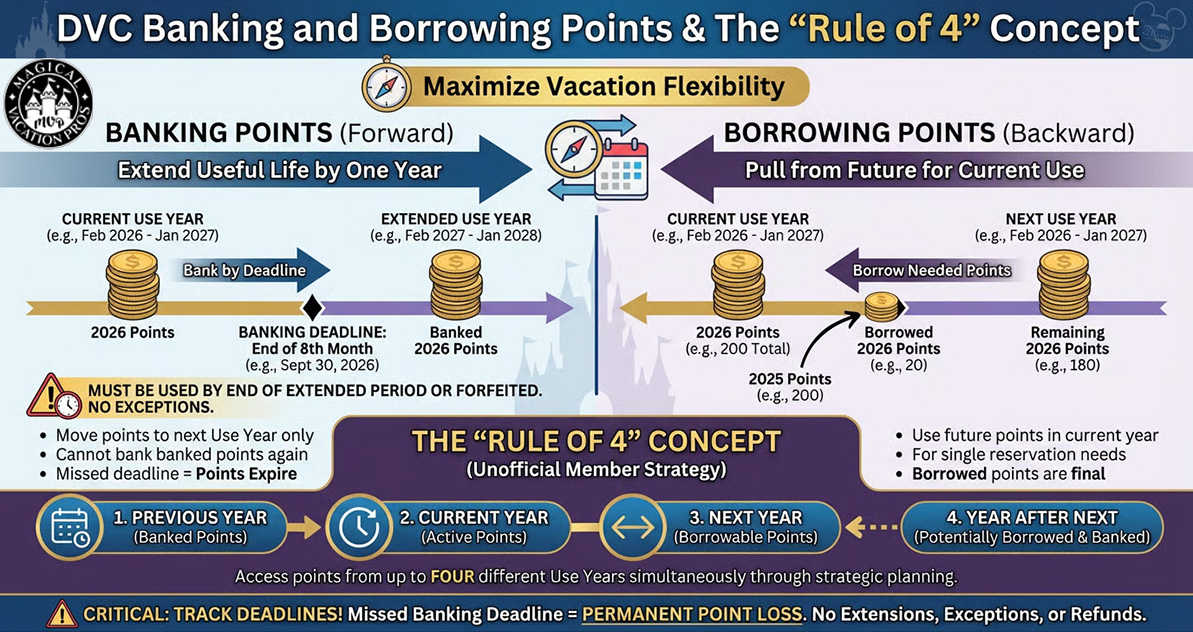
Banking and Borrowing Points (Including the “Rule of 4” Concept)
Disney allows members to bank points forward or borrow from a future use year, provided deadlines are met, creating a flexible system that helps members maximize their vacation planning options across multiple years. Banking points extends their useful life by one additional year—for example, an owner with a February use year receives 2026 points valid for stays between February 1, 2026 and January 31, 2027, but if those points cannot be used, they can be banked into the 2027 use year, effectively changing their usage period to February 1, 2027 through January 31, 2028.
However, points can only be banked forward one year, and if banked points are not used by the end of that extended period, they are forfeited with no exceptions. The critical banking deadline falls at the end of the eighth month of the use year—using the February example, points must be banked by September 30, 2026, or any unused points will expire on January 31, 2027. Borrowing works in the opposite direction, allowing members to pull points from their next use year into the current year when they need more points for a single reservation. For instance, an owner with 200 points and a February use year who needs 220 points in October 2025 can use their 200 points from the 2025 use year and borrow 20 points from the 2026 use year, leaving them with 180 points remaining for 2026.
The “Rule of 4” is an unofficial but widely recognized member concept stating that at any given time, a member can have access to points from up to four different use years through strategic banking and borrowing—their current year’s points, banked points from the previous year, the ability to borrow from next year, and potentially banked points that were borrowed from the year before. These rules are formally outlined in Disney Vacation Club documentation and represent a powerful tool for vacation flexibility, but members must carefully track deadlines as missed banking deadlines result in permanent point loss. A clear overview of DVC banking and borrowing rules is explained in beginner resources https://dvcnews.com/dvc-program-menu/buying-dvc/dvc-for-beginners. Miss the banking deadline and the points are gone—there are no extensions, exceptions, or refunds for expired points.
One-Time-Use Points from Disney
Disney allows members to purchase one-time-use points when they’re short for a reservation, providing a flexible solution for members who find themselves just shy of the points needed to complete a booking. These supplemental points are limited to a maximum of 24 points per use year and are currently priced at $22 per point as of February 2023, representing Disney’s standard pricing for this convenience feature. The one-time-use points come with specific restrictions designed to prevent abuse of the system—they can only be purchased and used for reservations made within the seven-month booking window (meaning they cannot be used for home resort advantage bookings at 11 months), and they are non-refundable, non-transferrable, and cannot be banked into future use years like regular membership points.
This option serves as an alternative to borrowing points from the next use year, which would reduce the member’s available allocation for future trips. Members who consistently find themselves purchasing one-time-use points or borrowing heavily from future years may want to consider adding to their point ownership through either a direct purchase add-on (minimum 25 points for cash purchases, 50 points for financed add-ons) or through the resale market.
The one-time-use point purchase option exemplifies DVC’s approach to providing flexibility while maintaining program integrity—it’s a convenience feature rather than a primary planning tool. This option is confirmed in DVC member guidance https://dvcnews.com/dvc-program-menu/buying-dvc/dvc-for-beginners

Buying Through the Resale Market
DVC resale contracts typically sell for significantly less than Disney’s direct pricing, while still carrying the same annual dues and core booking mechanics.
According to current market data, the savings can be substantial—ranging from $67.05 per point at Disneyland Hotel to $137.81 per point at Bay Lake Tower when comparing 2025 resale averages against Disney’s direct pricing.
For example, Old Key West contracts that originally sold for $48-$51 per point in 1991 are now averaging $91.65 per point on the resale market, demonstrating how certain DVC properties can appreciate over time despite being resale purchases.
The most important membership benefit remains fully intact for resale buyers: the ability to book accommodations at any DVC resort using your points, with identical 11-month home resort priority and 7-month booking windows for all other properties.
Beyond the upfront savings, resale buyers should carefully evaluate annual dues, which vary by resort and tend to increase gradually each year—for instance, Vero Beach may have attractive purchase prices but carries higher annual dues than properties like Grand Floridian Villas. Every resale transaction must undergo Disney’s Right of First Refusal (ROFR), meaning extremely low offers may be rejected as Disney exercises their option to purchase the contract themselves.
Licensed resale brokers document how resale buyers often save tens of thousands of dollars upfront compared to direct purchases, making the secondary market an attractive option for buyers who prioritize accommodations and core booking benefits over supplementary perks like Member Getaways or Disney Collection access https://www.fidelityrealestate.com/blog/long-term-value-of-disney-vacation-club-ownership/
Resale Restrictions
Resale contracts purchased after January 19, 2019 come with limitations that differentiate secondary market ownership from direct Disney purchases. These restrictions primarily affect supplementary membership benefits rather than the core ability to book DVC resort accommodations.
Resale owners maintain full access to the most important DVC benefit—booking stays at any DVC resort using points—with identical home resort priority at 11 months and general availability access at 7 months. Point management features including banking and borrowing function the same for all members.
However, resale purchasers face limitations on Member Getaways (point redemption for non-DVC hotels and destinations), the Disney Collection (which includes Disney Cruise Line, Adventures by Disney trips, and non-DVC Disney hotel stays), and various member discounts on dining, merchandise, and experiences.
Disney won’t let resale owners buy add-on points directly unless you pony up for a minimum direct purchase first. You can always snag more resale contracts on the secondary market though. What restrictions apply to you depends on when Disney originally sold the contract and what their policies were when it changed hands.
For most buyers, the substantial resale savings—often thousands of dollars per contract—far exceed the value of forfeited supplementary perks, particularly for families primarily focused on DVC resort stays who experience minimal practical limitation. These restrictions are clearly outlined by DVC resale specialists 👉 https://dvcsales.com/support/buying/understanding-dvc-resale-contract-restrictions
Renting Out or Renting Points
Disney has acknowledged increased enforcement related to commercial-scale point renting, while still allowing personal-use ownership.
As of June 2, 2025, DVC introduced a mandatory checkbox during the online booking process requiring members to confirm reservations are “for personal use only.” Disney updated their Terms & Conditions to back up this checkbox, giving themselves broad authority to decide what counts as commercial rental and enforce it however they want.
The revised terms explicitly state that personal use may include sharing reservations with family and friends occasionally, but prohibit members from regularly or frequently renting or selling reservations booked using their membership. DVC now decides whether reservations are personal or commercial at its sole discretion and can cancel or deny any reservations they believe are made for profit.
These changes appear to target members who own large point portfolios primarily for profit generation, particularly those who post multiple high-demand reservations for rent or rarely use their points personally. However, the policy maintains that occasional renting due to schedule changes, illness, or financial need remains within membership rights—the key distinction being intent and frequency rather than an outright prohibition. Recent policy changes are summarized here:
Points Expiration Rules
Here’s the hard truth about DVC points—if you don’t use them or bank them on time, they’re gone. No do-overs, no refunds, no “I forgot” exceptions. Disney doesn’t mess around with this stuff.
Your points expire at the end of your use year unless you bank them by that eighth-month deadline. Miss it and watch thousands of dollars evaporate. Disney’s rules spell it out bluntly: you must use your points for a reservation, bank them, borrow them, transfer them, or exchange them during your use year—or you lose them. That’s it. No asterisks, no fine print loopholes.
Let’s say you have a February use year. You get your 2026 points on February 1, 2026, and they’re good through January 31, 2027. Want to bank some into 2027? You’ve got until September 30, 2026—end of the eighth month. Come October 1st, that option’s off the table. Those points will vanish on January 31, 2027, and there’s nothing you can do about it.
And here’s a kicker most people don’t realize—Disney won’t refund points if you cancel on your arrival date or bail early.Disney considers your points used once you hit that check-in date, whether you show up or not. Complete no-show without calling? You lose every single point from that reservation. Zero refund.
Banked points follow the same brutal rules. You can’t bank them twice, and if you haven’t used them by the end of that second year, they’re toast. There’s no “oops, can I have those back?” button.
The full rulebook spells it all out 👉 https://disneyvacationclub.disney.go.com/media/dvc/languagespecific/eng/member/vacationplanning/rulesandregulations/HomeResortRulesandRegulations08102012.pdf
Set multiple calendar reminders for your banking deadlines. Put them in your phone, your email, wherever you’ll actually see them. These points cost you real money, and Disney’s not going to bail you out if you space on the dates. I’ve seen people lose thousands of dollars worth of points because they thought they had more time. Don’t be that person.